It’s one of the biggest design challenges we face in our homes today, isn’t it? That need for a dedicated workspace, smack dab in the middle of the room where we’re supposed to relax and unwind. The living room office combo. For years, I struggled with this myself. Our first attempt involved a hand-me-down desk that was sturdy but… let's just say it had 'corporate' written all over it. It sat in the corner like an unwelcome guest, a constant reminder of emails and deadlines, surrounded by a halo of visible cables.
It just never felt right. The living room is the heart of our home—it's where we pile on the sofa for movie nights, where the kids build forts, where we sip coffee on a slow Saturday morning. The last thing I wanted was for it to feel like a temporary cubicle. I knew there had to be a better way to create a space that was both productive and peaceful, functional and beautiful.
I think we’ve all seen the 'classic' take on the living room office. It often involves a well-intentioned attempt to carve out a distinct zone, but it can end up feeling disjointed. You have a heavy, dark desk, a high-backed ergonomic chair that looks like it belongs in a spaceship, and maybe a metal filing cabinet. It’s a solution born out of pure function, but it often ignores the feel of the room. It shouts, "I am an office!" instead of whispering, "I'm a cozy corner where you can get things done."
My approach is a little different. I believe the secret to a successful living room office combo is integration, not separation. Instead of trying to create a mini-office that clashes with your decor, the goal is to choose pieces that feel like they belong in a living room first. Think of it less as squeezing in a desk and more as adding another thoughtful, functional layer to your space. It’s about using furniture, materials, and styling tricks that harmonize with your sofa, your rug, and your art, creating a cohesive look that feels intentional and inviting. And the best part? This approach is often more budget-friendly and completely achievable, even in a rental.
So let's walk through some of my favorite ways to make this happen. I promise, you can have a workspace you love, right in the heart of your home.
The Secret Secretary Desk Nook
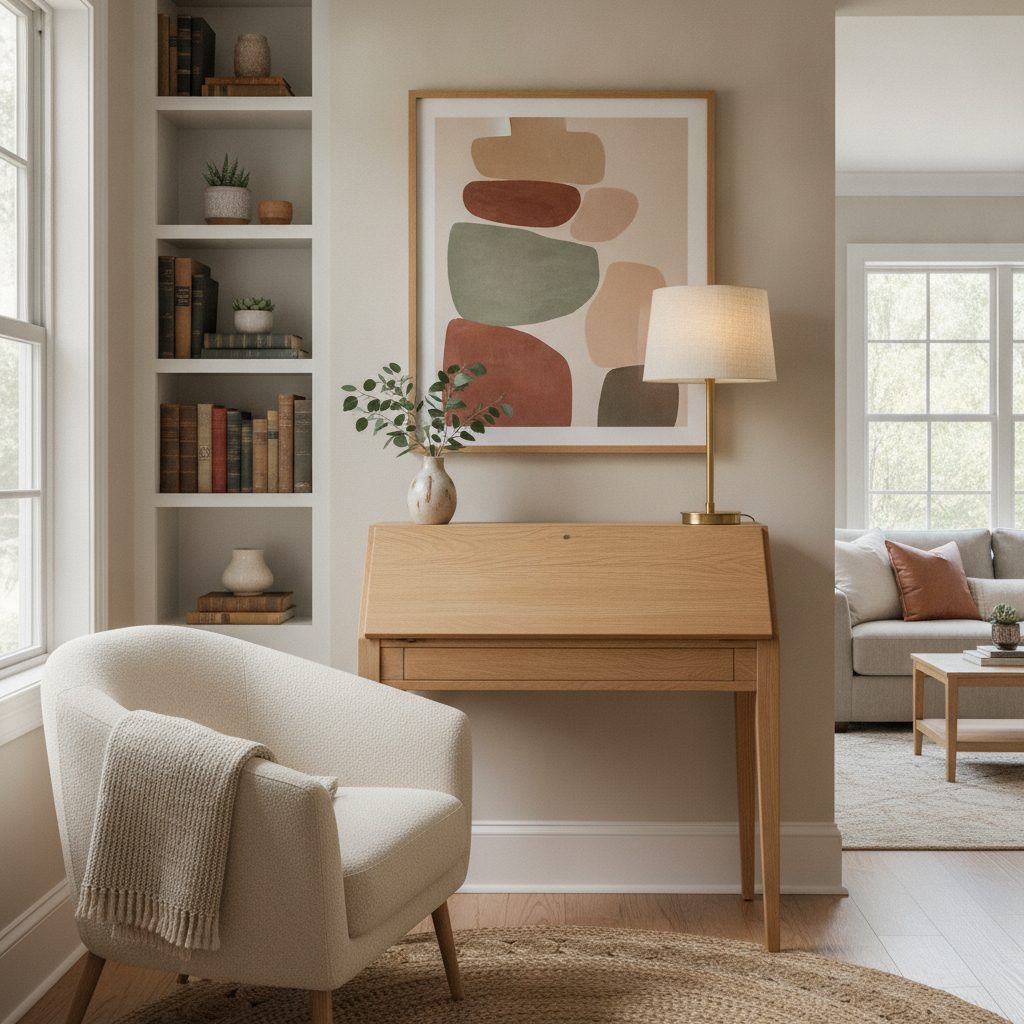
This is my go-to solution for anyone who wants a true 'out of sight, out of mind' workspace at the end of the day. The secretary desk has been around for centuries for a reason—it's brilliant! It’s a desk, console table, and storage cabinet all in one, with a magical flip-down door that hides your work life in an instant.
The Concept: You use a slim, stylish desk that can be closed up to look like a beautiful piece of accent furniture. When work is done, you close the front, and poof—the office is gone. It’s perfect for small spaces or for anyone who has a hard time mentally 'clocking out' when their laptop is staring at them during dinner.
How to Get the Look:
- The Desk: Look for modern interpretations of the secretary desk. You can find stunning versions in warm teak with mid-century modern lines, or sleek, lacquered styles in white or a deep navy blue. The key is to choose one with a profile that isn’t too deep, so it doesn't jut out into the room. A depth of 15-18 inches when closed is perfect.
- Placement: This is so versatile! Tuck it into an awkward, unused corner. Place it on a small wall between two windows to create a focal point. You can even place it behind your sofa, where it will function just like a console table when it's closed.
- The Chair: This is crucial. Ditch the office chair. Instead, opt for a beautiful upholstered dining chair, a velvet slipper chair without arms, or even a sturdy, carved wooden chair. You want something that looks like it could be pulled over for extra seating when guests are over. It immediately elevates the nook and makes it feel less utilitarian.
- Styling & Lighting: Treat the wall above the desk as a decorative moment. Hang a large, impactful piece of art or a beautiful round mirror. This draws the eye up and solidifies its identity as a decorative feature. For lighting, skip the clunky desk lamp and go for a small, ceramic-based table lamp with a linen shade or a plug-in wall sconce in a pretty brass or matte black finish.
Practical Notes:
- Budget-Friendly: Keep an eye on Facebook Marketplace and local vintage shops! I've seen so many beautiful, solid wood secretary desks from the 60s and 70s for a fraction of the price of new ones. A little wood oil can bring them right back to life.
- Renter-Friendly: This entire concept is a renter's dream. No permanent changes are needed. Use Command Strips to hang your art and a plug-in sconce to get that custom lighting look without touching the wiring.
- What to Avoid: Don’t overstuff it. A secretary desk works best for laptop users and those who can keep their paper clutter to a minimum. It’s not the place for a giant monitor and desktop tower.
The Library Wall Workstation
If you have a bit more space to play with and love a cozy, bookish vibe, this one is for you. It’s all about making your workspace feel like a deliberate, integrated part of a grander feature wall. It feels custom, thoughtful, and incredibly chic.
The Concept: Instead of a standalone desk, you integrate your work surface into a full wall of shelving. Your desk simply becomes one component of a larger, beautifully styled unit that houses books, decor, and hidden storage. This method is amazing for drawing the eye upward and making a room feel taller.
How to Get the Look:
- The Shelving: You can go high-end with modular systems from brands like Crate & Barrel or West Elm, but honestly, this is where IKEA is your best friend. The BILLY bookcase system is a classic for a reason. You can line up several tall, narrow bookcases to create the look of a custom built-in. Some systems, like PLATSA or BESTÅ, have desk attachments that integrate seamlessly.
- The Desk Surface: You can use a dedicated desk unit from the same system, or DIY it by cutting a piece of high-quality plywood or a kitchen countertop to fit between two shelving units. I love painting it the same color as the shelves (and even the wall!) for a high-end, monochromatic look.
- Placement: This works best on a long, uninterrupted wall in your living room. It can become the new focal point, replacing the wall where a TV might traditionally go.
- The Chair: Since the desk is part of a larger unit, you have more license to use a slightly more ergonomic chair. I’d look for one with a bit of style, though—perhaps a low-profile desk chair in a warm tan leather or a grey tweed fabric that complements your sofa.
- Styling & Lighting: This is everything! Style the shelves with the 60/30/10 rule: 60% books (arranged both vertically and horizontally), 30% decorative objects (vases, sculptures, framed photos), and 10% empty space to let it breathe. Use beautiful woven baskets or linen-covered boxes on the lower shelves to hide printers, paper, and other office supplies. For lighting, you can install battery-operated puck lights under the shelf directly above your desk or place a slim, elegant floor lamp right beside it.
Practical Notes:
- Budget-Friendly: The IKEA hack is the way to go. To make it look more custom, you can add trim or crown molding to the top and bottom and paint everything one color. It’s a weekend project that delivers huge impact.
- Renter-Friendly: While it looks built-in, you can achieve this without a single nail. Just be sure to use the included anti-tip hardware to safely secure the units to the wall (you'll only have a few small holes to patch later).
- What to Avoid: A sea of clutter. The key to the library wall is curated styling. Avoid using it as a dumping ground for odds and ends. Be ruthless about what gets displayed.
The Behind-the-Sofa Command Center
This is such a clever use of space, especially in an open-concept living area where the sofa “floats” in the middle of the room. It creates a distinct work zone without visually chopping up the space.
The Concept: You place a long, narrow desk or console table directly against the back of your sofa. The sofa itself acts as a visual and physical barrier, hiding the 'work' part of the desk from the 'living' part of the room.
How to Get the Look:
- The Desk: The key here is height and depth. You want a table that’s the same height as the back of your sofa, or just slightly lower. And it needs to be narrow—a depth of 16-20 inches is ideal. A simple Parsons-style desk, a waterfall console table, or even a DIY top with hairpin legs works perfectly. It should be about the same length as your sofa for a clean, intentional look.
- Placement: Snug it right up against the back of your sofa. This single move defines the space and creates a functional 'command center.'
- The Chair: This is the place for a backless stool or a very low-back chair. You want something that can be tucked completely under the desk when you’re not working, so it completely disappears from view.
- Styling & Lighting: Think 'console table styling.' This is not the place for piles of paper. Use a large tray to corral your laptop and a notebook. Add a pair of matching table lamps on either end for symmetry and excellent task lighting. A pretty vase with fresh greenery and a decorative bowl for keys or paperclips completes the look. It should look like a beautifully styled entryway table.
Practical Notes:
- Budget-Friendly: This is one of the easiest desks to DIY! A simple plank of wood from a hardware store and a set of metal legs from Amazon can create a custom-sized console desk for under $100.
- Renter-Friendly: Absolutely zero permanent changes are needed. It’s just a piece of furniture!
- What to Avoid: Cable chaos! This is the number one thing that will ruin the look. Invest in a cable sleeve or a cable box to bundle your cords together. Run them down one of the desk legs and along the back of the sofa to the nearest outlet. Adhesive cable clips are your friend here.
The Cozy Corner Vignette
My final idea is to lean into the office corner and make it a destination. Instead of trying to make it disappear, you treat it with the same care and attention as you would a cozy reading nook or a bar cart corner.
The Concept: You create a small, self-contained, and beautifully styled 'moment' in a corner. It’s less about a full-blown office and more about a charming spot for writing, paying bills, or working from home for a few hours.
How to Get the Look:
- The Desk: Choose a desk with personality. This is the place for a piece with some character—a vintage wooden writing desk with curved legs, a small pedestal desk, or a modern piece with interesting brass details. It doesn't need to be large, just large enough for your laptop and a notebook.
- Placement: Find a neglected corner and claim it. The corner provides a natural sense of enclosure and focus.
- The Chair: The chair is a co-star here. It must be comfortable and beautiful. Think of a small-scale accent chair—something in a bouclé fabric, a channel-tufted velvet, or a classic rattan frame with a cushion. It should be a chair you’d be happy to have as extra seating.
- Styling & Lighting: This is what makes it a vignette. Anchor the zone with a small, round rug (a 4-foot jute or patterned rug is perfect) placed under the front legs of the desk and chair. This visually separates it from the rest of the living room floor. Hang a small, curated gallery wall on the two walls of the corner. Use a mix of art and personal photos. Add a tall fiddle leaf fig or snake plant in a beautiful ceramic pot right in the corner behind the desk. For lighting, a dramatic floor lamp that arcs over the desk adds both function and major style points.
Practical Notes:
- Budget-Friendly: Again, second-hand is your friend for finding a desk with character. You can find amazing small rugs at discount home stores or online.
- Renter-Friendly: Using a rug to define a zone is a classic renter's trick. And a gallery wall can be easily created with removable picture-hanging strips.
- What to Avoid: Don't let it become an island of misfit toys. The styling must connect to the rest of the living room. Pull a color from your sofa pillows for one of the art prints, or match the metal of the floor lamp to the metal on your coffee table.
My Top Styling Tricks to Tie It All Together
No matter which idea you choose, these final touches will make your workspace feel truly seamless.
-
Create Cohesion Through Repetition: The easiest way to make your office area feel like it belongs is to repeat materials, colors, and textures. If your living room has warm wood tones, choose a wooden desk. Have brass curtain rods? Find a brass lamp for your desk. Pulled in a deep olive green in your throw pillows? Find a ceramic mug in that same shade to hold your pens.
-
Conceal the Clutter (Beautifully): Office supplies are rarely pretty. This is where decorative storage is non-negotiable. Get a set of beautiful lidded boxes to store papers and chargers. Find a woven basket to slide under the desk for your planner and extra notebooks. Use a small, pretty tray to corral sticky notes and paper clips.
-
Master Your Cable Management: I mentioned it before, but it bears repeating. Nothing screams 'office' like a tangled mess of black cords. Use velcro ties, cable sleeves that zip up, or an adhesive cable channel you can paint the same color as your wall. It's a small detail that makes a world of difference.
-
The 'End of Day' Ritual: This is more of a habit than a hack, but it’s so important. Create a simple 2-minute routine for the end of your workday. Wipe down your desk, put your laptop in its sleeve or drawer, stack papers neatly into a box, and turn off the task light. It’s a signal to your brain that work is over, and it returns your living room to a place of rest.
Frequently Asked Questions
How do I light my desk without it looking like a corporate office? Think in layers, just like you do with your living room lighting. Instead of a generic adjustable-arm desk lamp, use a beautiful table lamp with a fabric shade, a sleek plug-in wall sconce, or a sculptural floor lamp. The key is to choose lighting that adds to the room's ambiance.
What's the best desk chair that doesn't scream 'office'? Look in the dining chair or accent chair section! Upholstered dining chairs are often the perfect height and provide good support for a few hours of work. Small-scale accent chairs, especially slipper chairs (armless ones), are also a fantastic, stylish option. Just be honest about how many hours you'll be sitting there—if it's a full 8-hour day, you may need to find a hybrid option that blends ergonomics with better-than-average style.
How can I manage all my papers and files without a big filing cabinet? First, go digital as much as possible! For the papers you must keep, think outside the metal box. A set of three or four identical, beautiful magazine files on a shelf looks chic. A small credenza or sideboard can have files hidden inside. And never underestimate the power of a gorgeous lidded box labeled with a simple tag.
My living room is truly tiny. Can I still make this work? Absolutely! This is where you get creative. Look for a wall-mounted floating desk that takes up zero floor space. A 'ladder desk' is another great option that has a small footprint but offers vertical storage. Or, try the secretary desk idea—it’s a small-space superhero.
Creating a workspace in your living room doesn’t have to be a compromise. It’s an opportunity to be creative and intentional, to design a corner of your home that is just as inspiring as it is productive. I hope these ideas help you see the possibilities in your own space. You can absolutely carve out a spot that serves your needs while still feeling like the warm, welcoming heart of your home.